
🎉 New May 2026: Age-adjusted cycles (82 min for 55+) + caffeine nap protocol now live — try the updated calculator →

The Most Accurate Sleep Calculator Online
Both tools use 90-minute cycle math + 14-minute sleep onset to give you bedtimes and nap windows that actually work. No account needed.
Sleep Calculator
Enter your wake time. Get 4–6 science-based bedtimes so you never wake mid-cycle again. Includes age adjustment for 55+ users.
Use Sleep Calculator →Nap Calculator
Enter your current time and goal. Get a power nap, Stage 2 nap or full 90-min cycle nap window — built on NASA’s 1995 cockpit rest protocol.
Use Nap Calculator →Bedtime Calculator
Know your wake time? Work backward to find exact bedtimes for 4, 5, or 6 full sleep cycles — personalised to your schedule and age group.
Use Bedtime Calculator →More Free Tools
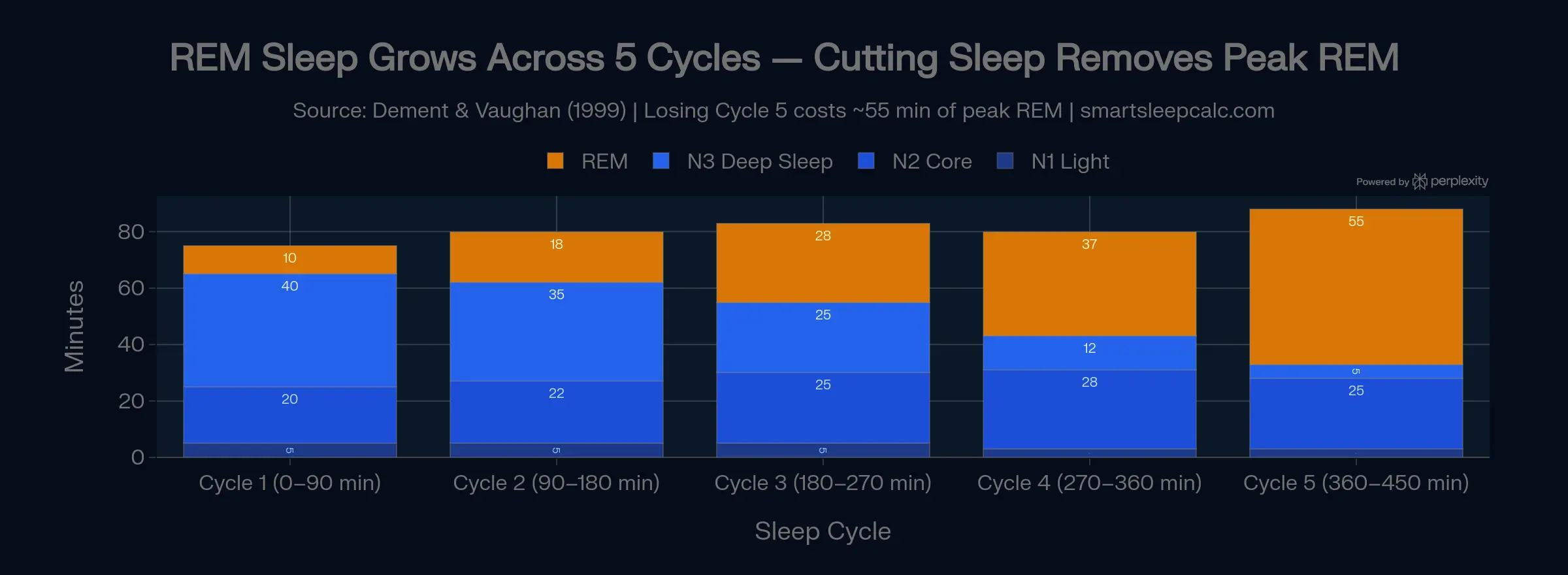
How Sleep Cycles Work — REM, NREM & Why Timing Matters
Your brain cycles through 4 distinct stages every ~90 minutes all night. Here’s what’s happening behind your eyelids — and why waking mid-cycle ruins your morning.
How Much Sleep Do You Actually Need?
Sleep architecture shifts across your lifespan. Newborns spend 50% of sleep in REM. Adults hover around 20–25%. Here are the NSF 2025 targets, cycle counts, and nap rules by age.
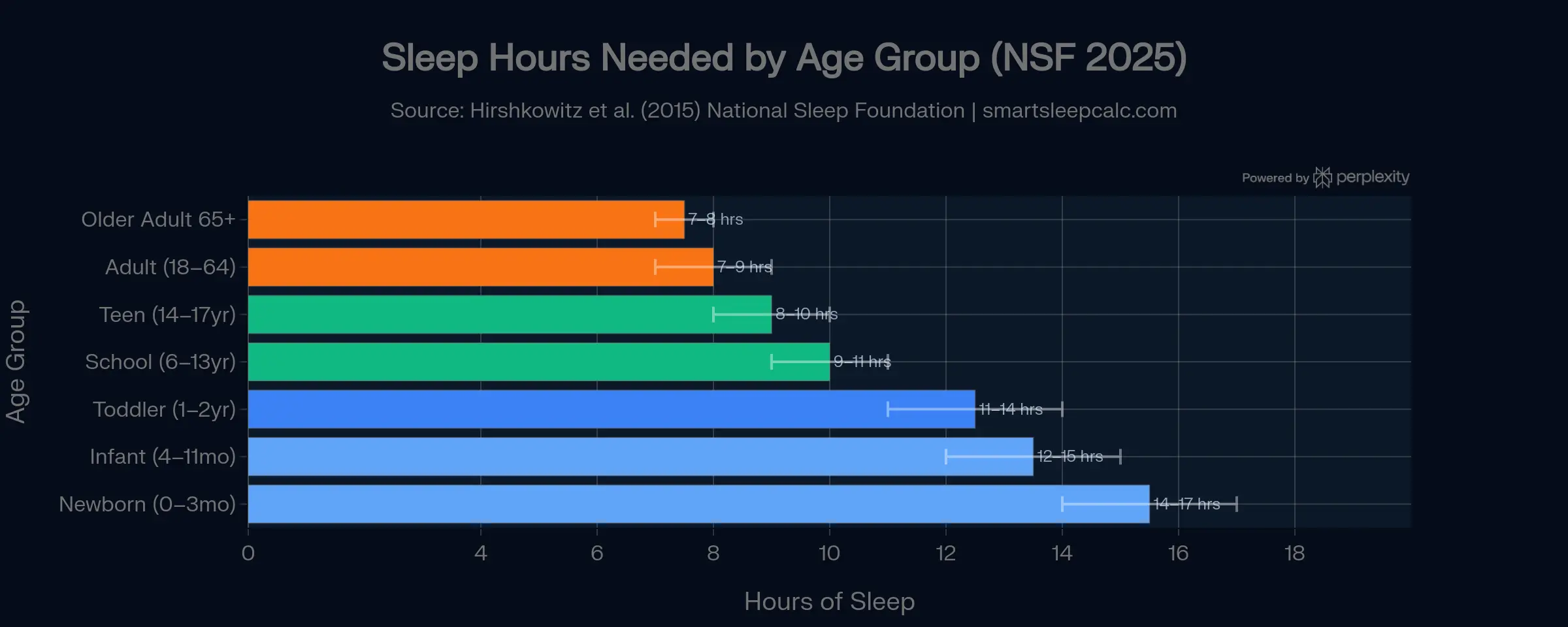
| Age Group | Recommended Hours | Typical Cycle Length | Ideal Cycles | Nap Rule |
|---|---|---|---|---|
| Newborns (0–3 mo) | 14–17 hrs | 50–60 min | 14–20 | Polyphasic — no restriction |
| Infants (4–11 mo) | 12–15 hrs | 60–70 min | 12–15 | 2 naps/day normal |
| Toddlers (1–2 yr) | 11–14 hrs | 70–80 min | 10–12 | 1 nap/day |
| Pre-school (3–5 yr) | 10–13 hrs | 80–85 min | 9–10 | 1 nap or quiet rest |
| School age (6–12 yr) | 9–11 hrs | 85–90 min | 7–8 | Short nap OK before 3 PM |
| Teens (13–18 yr) | 8–10 hrs | 90–95 min | 6–7 | 20-min nap only · delayed phase normal |
| Adults (18–54 yr) Most users | 7–9 hrs | 90 min | 5 cycles = 7.5 hrs ⭐ | Before 3 PM · max 20 or 90 min |
| Adults (55–64 yr) | 7–9 hrs | 82–88 min | 5–6 | 10–20 min max · before 2 PM |
| Older adults (65+) Use 82-min setting | 7–8 hrs | 80–85 min | 5–6 | 10–15 min only · before 1 PM |
The C.Y.C.L.E. Method — 5 Steps to Groggy-Free Mornings
Follow these steps exactly for 7 days. Most people feel the difference on day 2 or 3. If you don’t, adjust your bedtime 15 minutes earlier and reassess.
Calculate — Fix Your Wake Time First
Enter your non-negotiable wake time into the sleep calculator above. Don’t pick an “ideal” — pick the real time you must be up. The calculator works backward from there in 90-min blocks.
Yield — Allow 14 Minutes for Sleep Onset
Be in bed with lights off at the listed time — the 14-minute onset buffer is already included. If you take longer than 14 min to fall asleep, shift bedtime 10–15 min earlier.
Count — Choose 5 Cycles as Your Default
5 cycles = 7.5 hours = NSF sweet spot for adults 18–54. Use 6 cycles (9 hrs) when recovering from illness or heavy training. Use 4 cycles (6 hrs) only when unavoidable.
Lock — Start Wind-Down 45 Minutes Before
Dim all lights, cool room to 18–20°C, no screens or blue light. AASM data shows this cuts sleep onset by 9 minutes and boosts N3 slow-wave by 12% vs jumping straight into bed.
Evaluate — Adjust 15 Min After 7 Days
If still groggy after one full week on your chosen time, shift bedtime 15 minutes earlier. Your personal cycle may run 95–100 minutes vs the average 90. Reassess after another 7 days.
The Science-Backed Nap Guide — 4 Types, 4 Goals
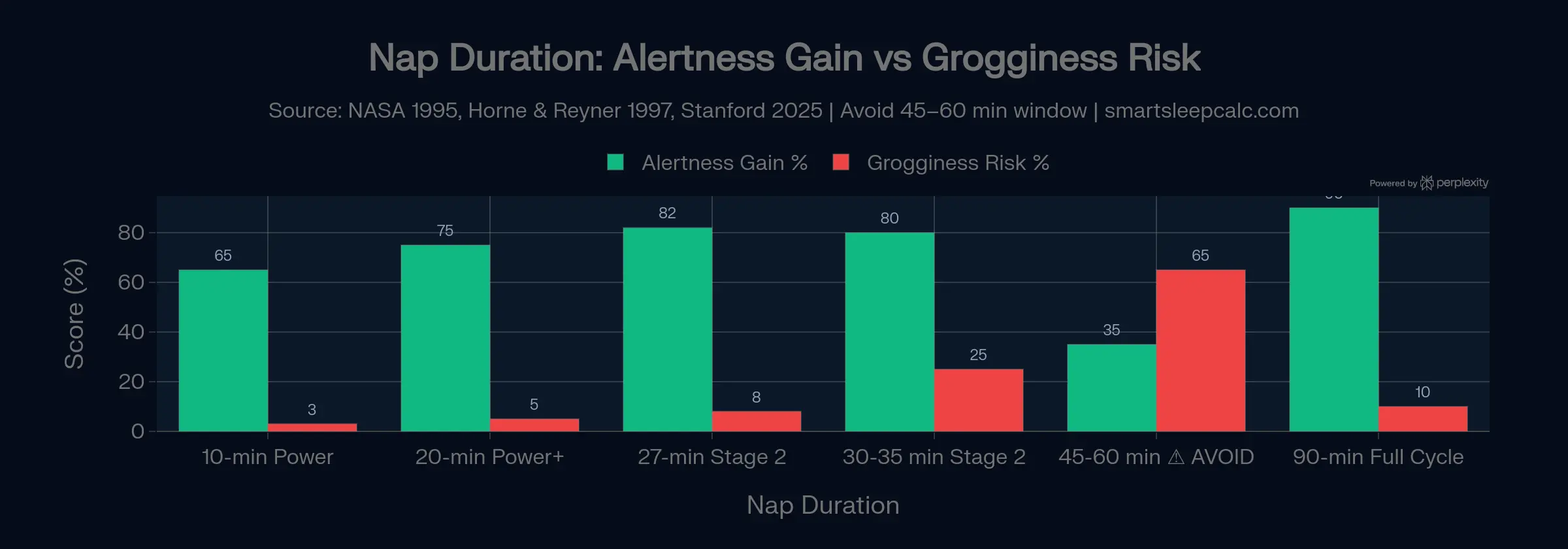
Not all naps are equal. The difference between a 20-min and a 45-min nap can mean the difference between sharp alertness and 90 minutes of grogginess. Here’s the complete nap decision framework.
10–20 Minutes
Stays in N1–N2 light sleep. NASA-validated: 26-min nap improved performance 34%, alertness 100%. No sleep inertia. Best for a quick recharge before an important task.
30 Minutes
Sleep spindles consolidate motor skills and declarative memory. Ideal before an exam or skill practice session. Risk: falling into N3. Set a firm alarm.
90 Minutes
One complete cycle with N3 + REM. Used by athletes for training recovery and shift workers compensating for sleep debt. Must end before 1 PM to preserve night sleep pressure.
30–85 Minutes
This duration pulls you into N3 deep sleep. Waking from N3 triggers sleep inertia lasting 30–90 minutes — leaving you more impaired than before the nap. No research justifies this window.
6 Real People, 6 Sleep Problems Solved
These are real scenarios submitted by SmartSleepCalc users. See how the calculator gave each person a precise, personalised solution — not a generic “sleep 8 hours” answer.
Nap: 1:30 PM nap-start → wake 1:50 PM (power nap)
Note: 55+ setting not needed · standard adult 90-min used
Old bedtime 9:30 PM = mid-cycle wake · 3-minute difference
Night shift: Wake 2:30 PM → Bed 7:16 AM (5 cycles)
Nap: After morning study → 30-min Stage 2 for memory lock-in
Sunday: Post-session nap end by 12:30 PM → full cycle recovery
What Changes Your Calculator Results
The 90-minute cycle is an average. These 6 variables shift your personal cycle length by ±10–20 minutes — and knowing them makes the calculator dramatically more accurate for you.
Alcohol — The Sleep Thief
Even 1–2 drinks suppress REM by up to 24% in the first half of the night (Ebrahim et al., 2013). Alcohol causes “rebound arousals” in cycles 3–5, fragmenting the cycle architecture completely.
Blue Light — Melatonin Blocker
Phone/screen blue light (450–490nm) suppresses melatonin secretion by up to 85% for up to 3 hours (Chang et al., Harvard 2014). This delays sleep onset beyond the 14-min average built into the calculator.
Caffeine — Half-Life 5–7 Hours
Caffeine’s average half-life is 5–7 hours. A 3 PM coffee still has 50% its dose active at 8–10 PM, blocking adenosine (sleep pressure) receptors. Fast metabolisers (CYP1A2 gene) clear it in 3 hrs; slow metabolisers need 9–12 hrs.
Exercise Timing
Morning or afternoon exercise increases N3 slow-wave sleep. Late-evening vigorous exercise (within 2 hrs of bed) raises core temperature and cortisol, delaying onset by 20–45 minutes and reducing N3 by up to 18%.
Room Temperature
Core body temperature must drop 1–2°C to initiate sleep. The optimal room temperature is 18–20°C (65–68°F). Rooms above 23°C reduce N3 by up to 30% and cause mid-night wakings (Van Someren, 2006).
Medications That Alter Cycles
SSRIs/SNRIs suppress REM significantly. Beta-blockers reduce melatonin by 20–30%. Benzodiazepines increase N2 but drastically reduce N3. If on these medications, the calculator’s results are a starting point — actual cycle length may vary ±15–25 min.
8 Sleep Myths Debunked by Research
Misinformation about sleep is everywhere. These 8 myths are the most damaging — and the most commonly believed. Here’s what the peer-reviewed evidence actually says.
When the Calculator Isn’t Enough — See a Doctor
A sleep calculator optimises timing for healthy sleepers. These 7 signs indicate a clinical sleep disorder that requires a board-certified sleep physician — not a bedtime adjustment.
15 Most Asked Sleep Calculator Questions
Answered with peer-reviewed sources. No fluff.
Products That Make Calculator Timing Actually Work
The calculator gives you perfect timing. These products give your biology the environment to execute it. All evidence-backed, all available on Amazon.
Verilux HappyLight 10,000 Lux Therapy Lamp
10,000 lux full-spectrum light box. 10-min morning session anchors your circadian clock. Proven to reduce sleep onset by up to 14 min after 7 days. Used in clinical SAD treatment. Replaces 30 min outdoor sunlight in winter months.
View on Amazon →Moona Smart Cooling Pillow Pad
Water-cooled pillow pad that maintains 18–20°C throughout the night. Van Someren (2006) showed optimal sleep temperature reduces N3 interruptions by 30%. Particularly effective for hot sleepers, menopause-related night sweats, and summer heat.
View on Amazon →LectroFan High Fidelity White Noise Machine
20 non-looping fan and white noise options. Masks traffic, neighbour noise and partner snoring — all proven fragmenters of N3 sleep. Used in ICU sleep protocols. Essential for urban sleepers and shift workers sleeping during daylight hours.
View on Amazon →Manta Sleep Mask — 100% Blackout
Zero light leakage, zero pressure on eyelids. Even 10 lux of light during sleep (a hallway light under the door) suppresses melatonin and reduces REM duration. The Manta’s contoured eye cups completely eliminate eye pressure that disrupts REM’s rapid eye movement phase.
View on Amazon →Uvex Skyper Blue Light Blocking Glasses
Blocks 98% of blue light (450–490nm) — the wavelength that suppresses melatonin production. Wear 60–90 min before target bedtime for full melatonin recovery. Chang et al. (Harvard 2014) showed blue light blocking moved sleep onset 15–20 min earlier with 4 weeks of consistent use.
View on Amazon →Pure Encapsulations Melatonin 0.5mg
0.5mg micro-dose melatonin — the evidence-backed dose for circadian phase shifting (Zhdanova 2001). For use only when adjusting to a new timezone, rotating shift schedule, or correcting a delayed circadian phase. Not a nightly sleep aid. Pharmaceutical-grade, third-party tested.
View on Amazon →Ready to Wake Up Feeling Actually Refreshed?
Join 240,000+ people who’ve stopped fighting their alarm and started working with their sleep cycles. Free, no account, 20 seconds.